Heat Pumps in Scotland: Top 10 FAQs for Homeowners
Written by: Liam | Published: February 26, 2026
How Does an Air Source Heat Pump Work?
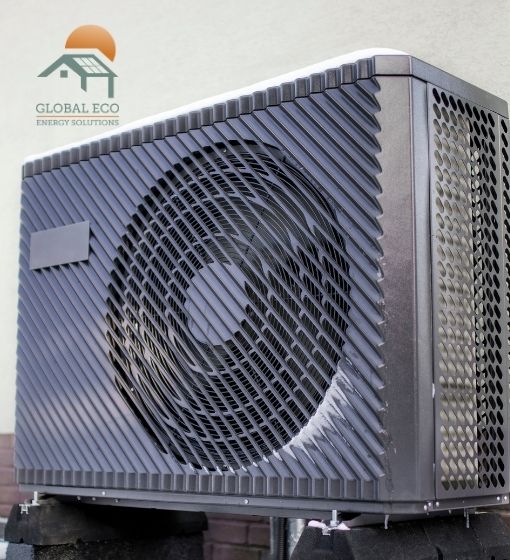
An air source heat pump (ASHP) extracts heat from the outside air and uses electricity to raise that heat to a higher temperature. It then distributed this heat throughout your home via radiators, underfloor heating, or a hot water cylinder.
Unlike traditional gas boilers, which typically heat water to 60–75°C, heat pumps operate at lower flow temperatures of around 35–55°C. This is why good insulation and appropriately sized radiators are so important – the system runs more steadily and efficiently at these lower temperatures.
Are Air Source Heat Pumps Efficient in the UK Climate?
Yes. Air source heat pumps are designed to work effectively in the UK climate, including winter conditions.
Typically, an ASHP operates at 200-400% efficiency (often expressed as a Coefficient of Performance, or COP, of 2-4). This means that for every unit of electricity used, the system produces two to four units of heat energy.
However, what really matters is the Seasonal Coefficient of Performance (SCOP). SCOP measures the system’s average efficiency across the entire heating season, taking into account varying outdoor temperatures. In the UK, a well-designed system often achieves a SCOP of around 2.8-3.5 – meaning it delivers nearly three units of heat for every unit of electricity over the course of a year.
By comparison:
- Electric boilers are 100% efficient (1 unit of electricity produces 1 unit of heat)
- The best gas boilers reach around 92-94% efficiency
What About During Winter?
Heat pump efficiency reduces in very cold conditions – typically by around 15-20%. However, even in Winter, a properly designed system can still be more than twice as efficient as a gas boiler.
Air source heat pumps are widely adopted across Scandinavian and Nordic countries such as Norway, Sweden and Finland, where they operate successfully in winters far colder than those typically experienced in the UK.
How Much Does an Air Source Heat Pump Cost in the UK?
The average cost of installing an air source heat pump on top of the Government grant is £7,500, which can feel significant, although in Scotland you can apply for an interest free loan for up to £7,500. However, this is largely a one-off transition cost. Once a property has moved to a heat pump system, future replacement costs are comparable to replacing a boiler – and a well-installed heat pump can often last longer.
Financing options are increasingly available, and costs are expected to reduce as adoption increase.
Grants and Support in the UK
Scotland
In Scotland, homeowners can apply for support through Home Energy Scotland. You may quality for:
- A grant of up £7,500
- An additional £1,500 rural uplift
- An interest-free loan of up £7,500 payable over 12 years
England & Wales
For readers across the rest of the UK, the Boiler Upgrade Scheme (BUS) provides grants to help replace traditional fossil fuel boilers with low-carbon heating systems such as air source heat pumps.
- Grants of up to £7,500 are available
These funding options can significantly reduce the upfront cost of transitioning to a heat pump, making the switch more accessible.
Is My Home Suitable For An Air Source Heat Pump?
Technically, a heat pump can be installed in most UK homes – but it won’t necessarily run efficiently in all of them.
For best performance, you’ll need (or be willing to invest in);
- Good insulation: While there is no minimum EPC rating required, grant schemes require minimum loft insulation levels and filled cavity walls.
- Larger of high-efficiency radiators / underfloor heating: Because heat pumps run at lower temperatures, radiators often need a greater surface area.
- Outdoor space: A garden, patio, or suitable balcony area for the external unit.
- Indoor space for a hot water cylinder: Most homes require a 200-250 litre cylinder.
To access any government funding, a full heat loss survey must be carried out to confirm suitability and correct system sizing. Here at Global Echo Energy Solutions, we offer this service free of charge.
Planning Permissions & Regulations
In most cases, air source heat pumps fall under Permitted Development rights in the UK, meaning planning permission is not required. However, restrictions may apply for:
- Listed buildings
- Properties in conservation areas
- Flats and shared building
Always check with your local authority if you are unsure.
What About Flats or High-Rise Buildings?
If you live in a flat and have access to a suitable balcony or external wall, installation may still be possible, subject to structural considerations and freeholder approval.
How Much Does It Cost To Run An Air Source Heat Pump?
Running costs depend on:
- Electricity prices
- Insulation levels
- System design and SCOP
- Your chosen energy tariff
If you currently use electric or oil heating, switching to an ASHP could reduce running costs by around 25-40% or more.
For gas boiler users, running costs can be comparable at current energy prices. However, in well-insulated homes using smart tariffs, heat pumps can be cheaper to run – particularly when paired with solar PV and battery storage.
Because heat pumps run on electricity, pairing them with solar panels and a battery system can significantly reduce running costs and increase energy dependance. A standalone battery can also help you benefit from time-of-use tariffs by storing electricity during off-peak periods for later use.
How Noisy Are Air Source Heat Pumps?
Modern heat pumps are typically around 40 decibels (dB) – similar to a refrigerator. During peak operation in cold weather, noise levels may rise to around 55-60 dB.
Older models were louder, which is where much of the noise myth originated. Today’s systems are compact, efficient and relatively quiet. Because the unit is installed outside the home, operational noise is rarely intrusive.
How Energy Efficient Are Air Source Heat Pumps?
Air source heat pumps typically operate at around 300% efficiency, meaning for every 1 kWh of electricity used, around 3 kWh of heat is used.
The average UK home uses approximately 12,000 kWh per year for heating and hot water. A heat pump could provide this heat output using roughly 4,000 kWh of electricity, depending on property efficiency.
Although electricity is currently more expensive per unit than gas, the UK’s long-term energy strategy is focused on electrification and renewable generation to meet 2050 net-zero targets – making heat pumps an increasingly future-proof choice.
How Much Does Maintenance Cost?
Maintenance requirements are relatively low. An annual service is recommended and typically costs similar to a boiler service.
Because heat pumps have fewer moving parts and no combustion process, they can experience less wear and tear over time.
How Long Do Air Source Heat Pumps Last?
With proper installation and annual servicing, an air source heat pump typically lasts over 20 years, making a reliable long-term heating solution.
Do Air Source Heat Pumps Work With Existing Radiators?
Yes – but system design is key.
Because heat pumps operate at lower flow temperatures, they may require:
- Larger radiatiors
- Or improved insulation
Your professional heat loss survey will determine whether your existing radiators need upgrading. At Global Eco Energy Solutions we offer a free, no-obligation assessment to evaluate suitability and optimise performance.
Should I Get Solar Panels and Battery Storage Too?
Solar panels are not requires for an ASHP to work efficiently. However, if you want maximum energy independence and lower long-term running costs, solar PV combined with battery storage is an excellent pairing.
Battery storage allows you to:
- Power your heat pump in the evening and early morning
- Store excess solar energy
- Take advantage of smart tariffs by charging during off-peak periods.